Picking the correct course after finishing Class 10 is a big choice for students who want to go into a technical field. If you like learning by doing, working with machines, building things, electrical systems, or electronics, a polytechnic diploma might be a good choice for you. Instead of going straight to college right after finishing high school, you can build up your technical skills and get ready for either more education or a job when you’re just starting out.
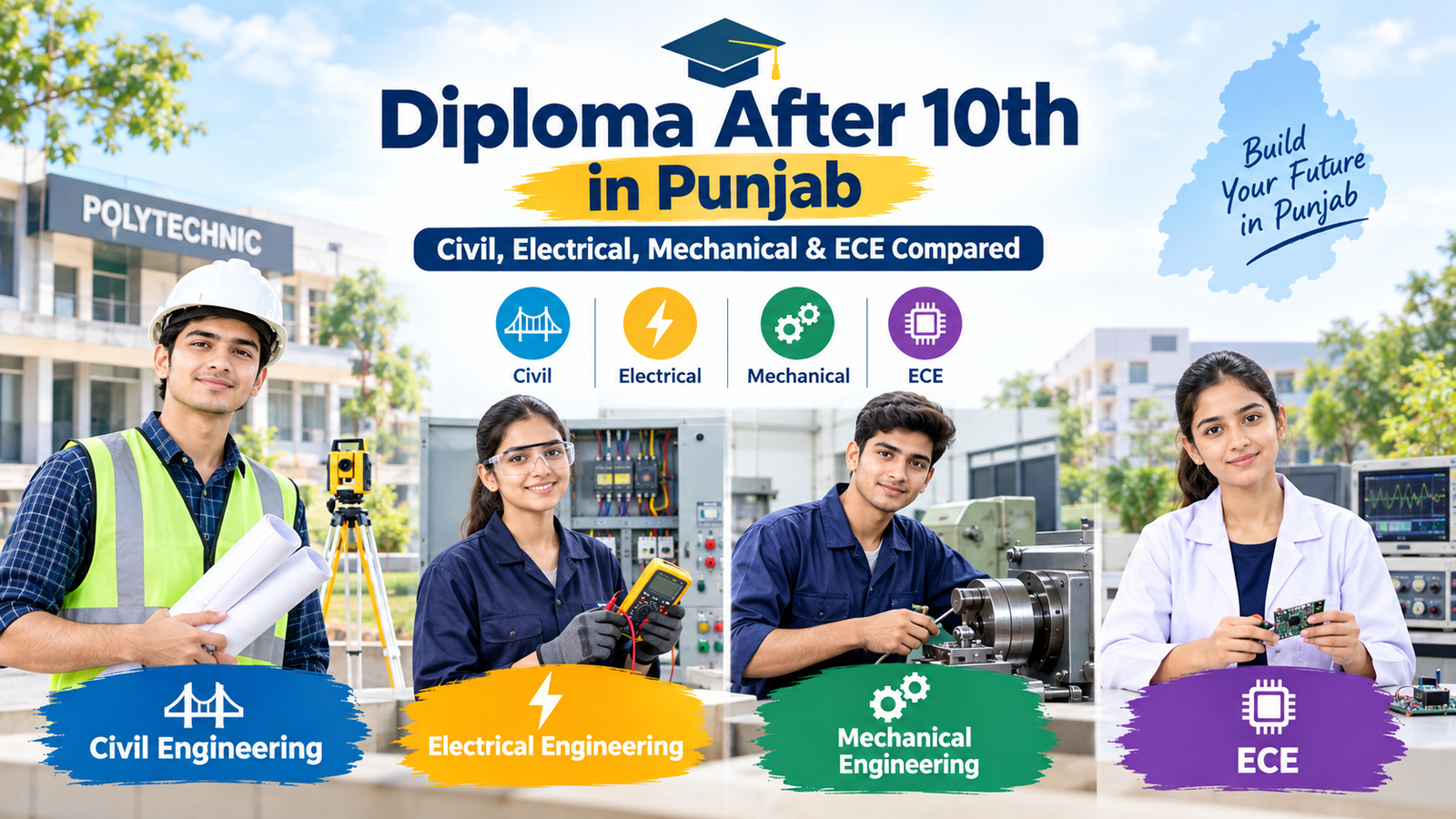
Four well-known engineering branches, namely Civil Engineering, Mechanical Engineering, Electrical Engineering, and Electronics and Communication Engineering (ECE), are recommended for students pursuing a Diploma course after 10th Punjab. Each branch covers different technologies, hands-on skills, and job options.
Before choosing a polytechnic institute, students from Kalanaur, Dera Baba Nanak and Batala can compare these options. Knowing about the subjects, how long the course will take, the hands-on training you’ll get, and what jobs or opportunities you might have after completing it can help you decide if it’s the right choice for you.
In this guide, we compare all four branches to help you figure out which diploma best fits your interests and future career plans.
What Is a Polytechnic Diploma After 10th?
A polytechnic diploma is a technical course that teaches students about engineering principles, real-world applications, and skills relevant to the industry. Admission to engineering diploma programmes after Class 10 is contingent on the institution’s eligibility criteria and applicable admission regulations.
These programs usually mix classroom lessons with lab work, workshops, hands-on tasks, and sometimes training at industries.
This course can be useful, read below:
- Learn technical and practical skills after matriculation.
- Explore a specific engineering specialisation.
- Prepare for technical employment opportunities.
- Keep going with your studies through approved lateral-entry or other higher education options.
- Establish a career in manufacturing, construction, maintenance, infrastructure or electronics.
The time taken to complete most standard engineering diploma courses after completing Class 10 is usually around three years. It is recommended that students verify the specific duration, eligibility criteria, and course arrangement with their chosen institute.
Civil vs Electrical vs Mechanical vs ECE: Quick Comparison
Prior to deciding on a branch, it’s important to compare the subjects you plan to study and the job duties that come with each specialization.
| Feature | Civil Engineering | Electrical Engineering | Mechanical Engineering | Electronics and Communication (ECE) |
|---|---|---|---|---|
| Main focus | Buildings, roads and infrastructure | Electricity and power systems | Machines and manufacturing | Electronic circuits and communication |
| Key subjects | Surveying, construction, materials | Electrical machines, circuits, power | Engineering drawing, thermodynamics, manufacturing | Digital electronics, communication, circuit fundamentals |
| Practical learning | Site work and surveying | Electrical laboratories and wiring | Workshops and machine operations | Electronics laboratories and circuit testing |
| Typical work environments | Construction sites and infrastructure projects | Industries, utilities and maintenance departments | Factories, workshops and production units | Electronics, telecom and technical service organisations |
| Suitable interests | Buildings, design and infrastructure | Electrical systems and power | Machines, tools and production | Circuits, devices and communication technology |
All four branches can result in technical jobs, but the subjects you study and the day-to-day work can be quite different. Your inclination towards a specific technology should be a crucial factor in your choice.
1. Diploma in Civil Engineering After 10th
This includes buildings, roads, bridges, drainage systems, and other structures that communities use.
If you are interested in exploring construction projects, measurements, building materials, and infrastructure development, Civil Engineering may be a suitable field for you.
What Will You Study?
There are many subjects such as:
- Engineering drawing
- Building materials and construction
- Surveying and levelling
- Construction technology
- Structural engineering fundamentals
- Soil mechanics
- Estimation and costing
- Water supply and environmental engineering
The exact syllabus can vary depending on the institute, university, or examining body.
Practical training might include using surveying tools, taking construction measurements, creating technical drawings, and testing building materials in a lab.
Career Opportunities After a Civil Diploma
After finishing a qualifying diploma, students might look into starting jobs like:
- Civil engineering technician
- Site supervisor trainee
- Surveying assistant
- Construction project assistant
- Estimation and costing assistant
- Quality-control technician
The employer’s requirements, practical abilities, and relevant experience are crucial for employment. Some jobs in government need you to take exams, have certain qualifications, and meet other requirements.
Who Should Choose Civil Engineering?
Civil Engineering may suit students who enjoy:
- Buildings, roads and infrastructure.
- Drawing, measurements and planning.
- Outdoor work and construction-site activities.
- Understanding how structures are built.
Students looking for polytechnic civil engineering colleges in Punjab should check the syllabus, workshop facilities, surveying tools, hands-on training, and opportunities for industry experience provided by each institution.
2. Diploma in Electrical Engineering After 10th
Students who want to learn about how electricity is made, sent and used in homes, office buildings and factories might find this field interesting.
What Will You Study?
An Electrical Engineering diploma commonly covers:
- Basic electrical engineering
- Electrical circuits and measurements
- Electrical machines
- Transformers and motors
- Power generation and distribution fundamentals
- Electrical installation and maintenance
- Electrical safety
- Control systems fundamentals
Students can use laboratory tools to learn about circuits, how to measure electricity, and how electrical machines work.
Safety is especially important in this field because electrical equipment can cause serious dangers if not handled properly.
Career Opportunities After an Electrical Diploma
Depending on the qualifications and what the employer is looking for, graduates might look into positions like:
- Electrical technician
- Maintenance technician
- Electrical installation assistant
- Industrial electrical technician
- Electrical testing assistant
- Solar installation or maintenance technician
More training can help students learn extra skills in areas like automation, renewable energy, industrial maintenance, or electrical testing.
Who Should Choose Electrical Engineering
Electrical Engineering could be a good choice if you enjoy:
- Understanding electricity and circuits.
- Working with motors and electrical equipment.
- Troubleshooting technical problems.
- Learning about power systems and industrial maintenance.
Taking an electrical engineering course after 10th grade can help build a strong base for more advanced technical studies, but it’s important for students to check the entry requirements and course structure before they apply.
3. Diploma in Mechanical Engineering After 10th
Mechanical Engineering deals with machines, how things are made, mechanical systems, production tools, and the basics of movement, force, and energy.
It can be a good option for students who like to learn about how machines work, how products are made, and how mechanical parts are created.
What Will You Study?
A Mechanical Engineering diploma may include:
- Engineering drawing and CAD fundamentals
- Engineering mechanics
- Workshop technology
- Manufacturing processes
- Thermodynamics
- Strength of materials
- Machine tools
- Fluid mechanics
- Quality control and production fundamentals
Practical sessions can show students how to use workshop tools, measuring devices, manufacturing techniques, and computer-aided design software.
Career Opportunities After a Mechanical Diploma
Possible entry-level career pathways include:
- Mechanical technician
- Production technician
- Manufacturing assistant
- Quality-control technician
- Maintenance technician
- A CAD drafting assistant, with the necessary software skills.
- Workshop technician
Industries like manufacturing, automotive parts, machinery production, and industrial maintenance might have suitable job opportunities.
Career progress usually relies on hands-on experience, knowing how to use software, getting extra certifications, and continuing to learn more.
Who Should Choose Mechanical Engineering?
Machines, engines and mechanical devices.
- Manufacturing and production processes.
- Workshop activities and practical problem-solving.
- Technical drawing and mechanical design.
A mechanical engineering diploma in Punjab is worth considering if your career interests lie in machinery, production, automotive technology, or industrial maintenance.
Before you get admitted, look into the workshop facilities, see what equipment is available, check if CAD training is offered, and find out about chances to get industrial experience.
4. Diploma in Electronics and Communication Engineering (ECE) After 10th
Electronics and Communication Engineering deals with electronic circuits, devices, communication systems, and technologies that enable electronic equipment to process or send information.
It could interest students who like working with electronic gadgets, circuit boards, digital systems, and communication technologies.
What Will You Study?
An ECE diploma may include:
- Electronic components and circuits
- Digital electronics
- Analog electronics
- Electronic measurements
- Microprocessors and microcontrollers
- Communication systems
- Basic embedded systems
- Computer and electronic hardware fundamentals
Practical learning might include building circuits, checking components, making electronic measurements, and working on fixing problems in electronic systems.
The exact topics covered will be based on the syllabus that has been approved for the programme.
Career Opportunities After an ECE Diploma
Depending on the employer and your actual skills, there are several possible options available.
- Electronics technician
- Electronic equipment maintenance technician
- Testing technician
- Communication equipment technician
- Electronics assembly technician
- Hardware service technician
- Embedded systems trainee, with appropriate additional skills
Students can also develop more skills in areas like automation, embedded systems, networking, or other fields related to electronics.
Who Should Choose ECE?
ECE may be suitable if you enjoy:
- Electronic devices and circuit boards.
- Understanding how digital equipment works.
- Troubleshooting hardware.
- Communication technology and embedded systems.
Choose this branch if you have an interest in electronic systems and want to build your hands-on skills with circuits, components, and technical tools.
Which Diploma Branch Is Best After 10th?
The right option depends on your interests, preferred work environment and plans for further education.
There are other choices:
- If you’re interested in buildings, construction, surveying, and infrastructure, then Civil Engineering is the right choice for you.
- If you like working with electrical devices, power systems, motors, and fixing electrical problems, then Electrical Engineering is the right field for you.
- Choose Mechanical Engineering if you like working with machines, making things, using tools, and being part of creating products.
- If you are interested in electronic circuits, communication devices, and digital technology, then ECE is the program for you.
Rather than choosing a course based solely on its popularity, consider the actual content and practical applications.
For example, a student who likes working outside might choose Civil Engineering, whereas someone who is interested in fixing electronic gadgets might go for ECE. A student who is really interested in machines might find Mechanical Engineering more interesting.
Eligibility for a Diploma Course After 10th in Punjab
However, the admission requirements may differ based on the course, the institution, and the specific admission policies that apply.
Before applying, check the following:
- Check the needed Class 10 qualification and any specific subject requirements.
- Admission process: Find out if admission is based on merit, requires an entrance exam, or follows another approved method.
- Make sure the program is recognized or approved by the right authorities.
- What is the current tuition fee and any extra charges?
- Gather up the necessary paperwork, such as a marksheet, identity papers, photographs, and other essential certificates.
Students should check the latest admission notice instead of depending on eligibility details from past years.
Diploma Course Duration and Study Options
Students should check the length of their selected course with the institution.
Eligible students can choose from a range of options after completing a diploma, including:
Continue with higher education: Based on the current admission policies, people who have a diploma may be eligible to enter a relevant B.Tech program through lateral entry.
Students can look for technical jobs that require their diploma qualification.
Develop specialized skills: Getting extra training in areas like CAD, industrial automation, electrical maintenance, electronics testing, or other related fields can help you get a better job.
Prepare for eligible recruitment examinations: Some public-sector and government technical roles accept specific diploma qualifications, depending on the applicable recruitment rules.
A diploma can serve as a good beginning for either getting a job or moving on to more education.
Conclusion
Choosing a diploma course after 10th Punjab can help you start developing important technical skills for more advanced studies and better job opportunities later on. Civil Engineering deals with construction and building structures, Electrical Engineering focuses on power systems and electrical devices, Mechanical Engineering involves machines and manufacturing processes, and ECE (Electronics and Communication Engineering) is related to electronic circuits and communication technologies.
If you are looking to study a diploma course after completing 10th grade in Punjab, it’s better to choose a branch that matches your interests instead of just picking the most popular one.
Students from Kalanaur, Dera Baba Nanak, and Batala can also look into polytechnic colleges in Gurdaspur and nearby regions. Before you decide, check the course options, the real-world tools and spaces available, what qualifications you need, how much it will cost, and what you can do next after finishing the course.
By doing some careful research and picking the right specialisation, you can take a practical first step towards a technical education path that fits your goals.